Executive Brief | Connected Healthcare. Better Outcomes
Explore how leading healthcare organizations are connecting workforce, finance, and supply chain to improve visibility, strengthen decision-making, and create better outcomes across the enterprise.
Healthcare organizations face growing pressure to strengthen financial performance, support a stretched workforce, and ensure critical supplies are available when and where they are needed. These priorities are often managed separately, but healthcare itself does not operate that way.
Care depends on three foundations: workforce, finance, and supply chain. Workforce ensures qualified clinicians are available to deliver care. Supply chain ensures clinicians have the resources they need. Finance sustains the people, supplies, and investments that keep the organization running. While each function has distinct priorities, all three ultimately support the same goal: delivering high-quality patient care.
The challenge is not that these functions exist independently. The challenge is that many organizations still manage them independently. Leading healthcare organizations are taking a different approach, creating stronger connections across workforce, finance, and supply chain to improve visibility, strengthen decision-making, and respond more effectively to change. When healthcare works together, better outcomes follow.
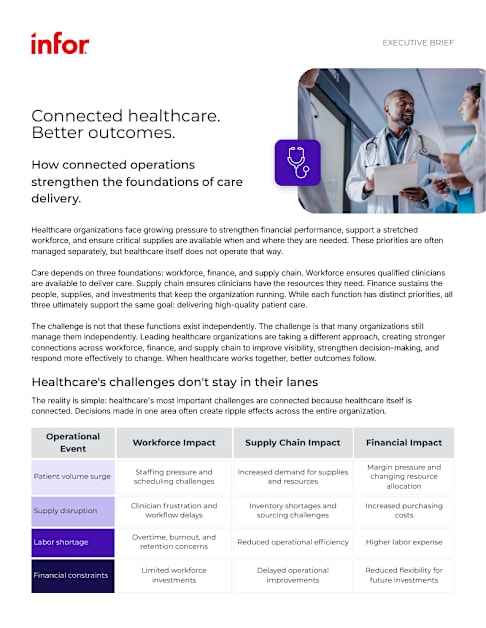
Operational Event
Workforce Impact Supply Chain Impact Financial Impact
Patient volume surge Staffing pressure and scheduling challenges
Increased demand for supplies and resources
Margin pressure and changing resource
allocation
Supply disruption Clinician frustration and
workflow delays Inventory shortages and
sourcing challenges Increased purchasing
costs
Labor shortage Overtime, burnout, and
retention concerns Reduced operational efficiency Higher labor expense
Financial constraints Limited workforce
investments Delayed operational
improvements Reduced flexibility for
future investments
Connected healthcare. Better outcomes.
How connected operations strengthen the foundations of care delivery.
EXECUTIVE BRIEF
Healthcare's challenges don't stay in their lanes The reality is simple: healthcare's most important challenges are connected because healthcare itself is connected. Decisions made in one area often create ripple effects across the entire organization.
EXECUTIVE BRIEFConnected Healthcare. Better Outcomes.
A connected foundation for care delivery
2
Workforce: Deliver Care
Supply Chain: Enable Care
Finance: Sustain Care
Ensure clinicians and staff are available and ready to deliver care
Ensure supplies are available when and where they are needed
Sustain the resources and investments that make care possible
Reduce burnout and administrative burden
Improve availability and operational resilience
Improve visibility, planning, and financial performance
Support a productive, engaged workforce Support efficient care delivery Support long-term organizational
sustainability
While healthcare leaders often focus on these areas through different operational lenses, their priorities are becoming increasingly interdependent. Workforce shortages can increase labor expense and affect productivity. Supply disruptions can impact both clinician efficiency and operating costs. Financial pressures influence decisions about staffing, technology, and resource allocation. Understanding how these foundations support one another is becoming critical to maintaining performance across the organization.
The financial impact of these pressures continues to grow. Recent healthcare benchmarking found supply expenses increasing 12.3% year over year while many organizations continue to navigate reimbursement pressure and tight operating margins (HFMA, 2026). As operational complexity grows, so does the need for a more connected approach.
Connected healthcare creates a shared operational foundation across workforce, supply chain, and finance. Leaders gain a more complete view of the factors influencing performance, allowing them to anticipate challenges, align resources, and make more informed decisions across the enterprise.
Connected operations create visibility across people, supplies, and financial performance, helping organizations manage the realities of care delivery as a single system rather than a collection of disconnected functions.
Each foundation plays a different role, but none can succeed in isolation.
EXECUTIVE BRIEFConnected Healthcare. Better Outcomes.
3
Why connection matters Disconnection often appears in everyday operational decisions. Workforce leaders may make staffing decisions without complete visibility into patient demand or financial constraints. Supply chain teams may respond to shortages without understanding the broader impact on clinician productivity and operating costs. Finance leaders may see the outcome of operational decisions without visibility into the conditions driving them.
These challenges are rarely caused by a lack of information. More often, information exists but remains disconnected from the people and processes that need it most.
Staff are available to meet patient demand Supplies are available when and where they are needed Leaders gain greater operational visibility Financial performance improves Care delivery is strengthened
A more coordinated operating model helps healthcare organizations deliver care more efficiently, sustainably, and effectively.
Organizations that connect workforce, finance, and supply chain are better positioned to achieve outcomes such as:
Artificial Intelligence (AI) helps healthcare organizations automate work and uncover insights that support faster decisions and better resource optimization.
But AI is only as effective as the data, processes, and workflows behind it. When workforce, finance, and supply chain operate in silos, information remains fragmented and opportunities are harder to identify. When those foundations are connected, AI can enable better decisions, reduce administrative burden, improve experiences, and help organizations respond more quickly to change.
AI adoption continues to accelerate across healthcare. In a 2026 industry survey by NVIDIA, 70% of organizations reported actively using AI and 69% reported using generative AI technologies, increasing the importance of connected operational data and trusted information foundations.
Data must be connected before it can become intelligence. Processes must be connected before they can be automated. Teams must be connected before technology can improve outcomes.
AI does not replace connected operations. It strengthens them.
AI Spotlight
Copyright © 2026 Infor. All rights reserved. The word and design marks set forth herein are trademarks and/or registered trademarks of Infor and/or related affiliates and subsidiaries. All other trademarks listed herein are the property of their respective owners. EB-EN-0926-86akbepap-1
LEARN MORE
infor.com
About Infor Infor is a global leader in business cloud software products for companies in industry- specific markets. Infor builds complete industry suites in the cloud and efficiently deploys technology that puts the user experience first, leverages data science, and integrates easily into existing systems. Over 67,000 organizations worldwide rely on Infor to help overcome market disruptions and achieve business-wide digital transformation.
Learn more about Infor
EXECUTIVE BRIEFConnected Healthcare. Better Outcomes.
Proof in Practice Healthcare organizations may begin with different operational challenges, but the opportunity is often the same: reduce friction, improve visibility, and create capacity across the enterprise.
Standardized systems and supplies across 11 hospitals to
improve visibility, reduce costs, and support more informed
operational decisions.
Automated manual financial workflows and supply chain processes to save time and
improve operational efficiency.
Moved from paper-based scheduling to connected
workforce operations, improving efficiency and
reducing administrative burden.
University of Maryland Medical System
Children's of Alabama
Confluence Health
Three different starting points. One common outcome: stronger performance through more connected operations.
When workforce, finance, and supply chain operate from a connected foundation, healthcare organizations can see and respond to operational challenges with a more complete view of the enterprise.
When patient demand changes, leaders can better understand staffing needs, supply requirements, and financial impact at the same time. Workforce teams can recruit, staff, and retain the people needed to deliver care with greater visibility, scheduling flexibility, and AI-assisted decision-making. Supply chain teams can help ensure clinicians have the supplies and resources they need, even as demand fluctuates. Finance teams can monitor performance, forecast more accurately, and sustain the investments required to support their mission.
Connected healthcare creates alignment across the functions that care delivery depends on. It helps organizations respond more effectively to change, improve operational performance, and keep their focus where it belongs: delivering high-quality patient care.
Connected Healthcare. Better Outcomes.
https://www.infor.com/solutions/erp/healthcare?utm_campaign=28158-003-005&utm_source=qr-code&utm_medium=print&utm_content=connectedhealth&utm_type=executive-briefs