A new star rising

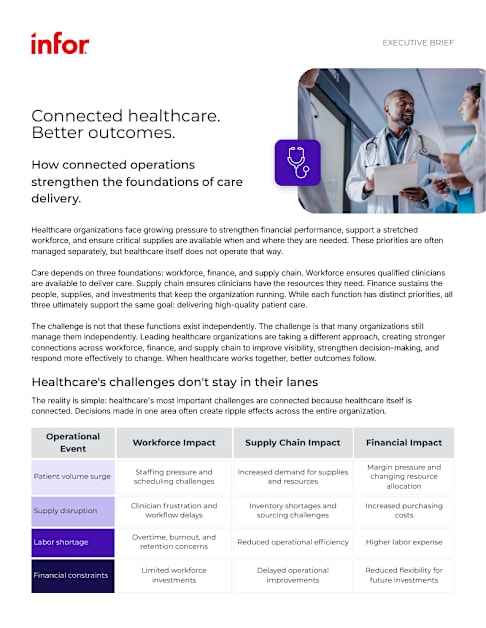
Connected Healthcare. Better Outcomes.

Workforce. Finance. Supply Chain. One connected foundation.

750+

U.S. healthcare organizations partnered with Infor

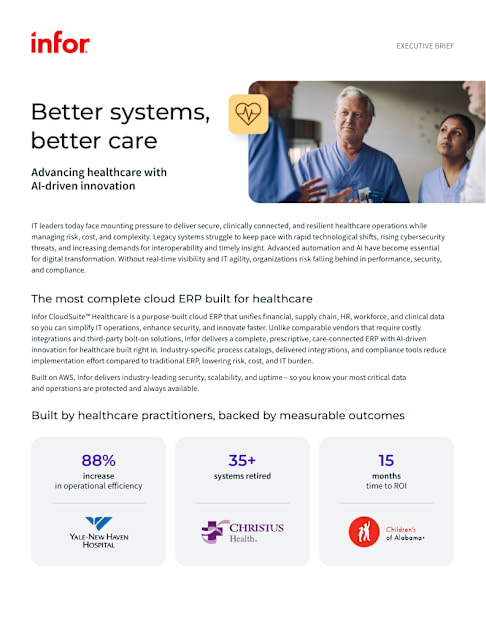
88%

Average increase in operational efficiency reported

15 months

Average time to ROI realization

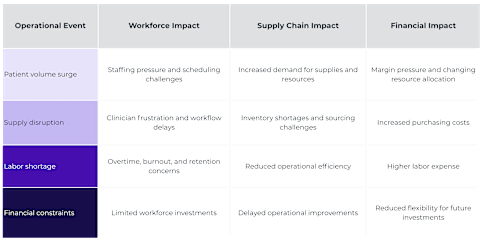
Healthcare challenges don't stay in their lanes.

A patient volume surge strains staffing, drives up supply demand, and pressures margins — simultaneously. A labor shortage increases overtime costs, reduces operational efficiency, and raises long-term financial risk. A supply disruption slows clinical workflows, frustrates care teams, and increases purchasing costs. These aren't separate budget lines managed by separate teams. They're the same connected pressure showing up differently depending on where you sit.
Healthcare's biggest challenges don't operate in silos, and neither should the systems used to address them. Read the executive brief to learn how healthcare organizations are connecting workforce, finance, and supply chain to improve operational performance and deliver better outcomes.
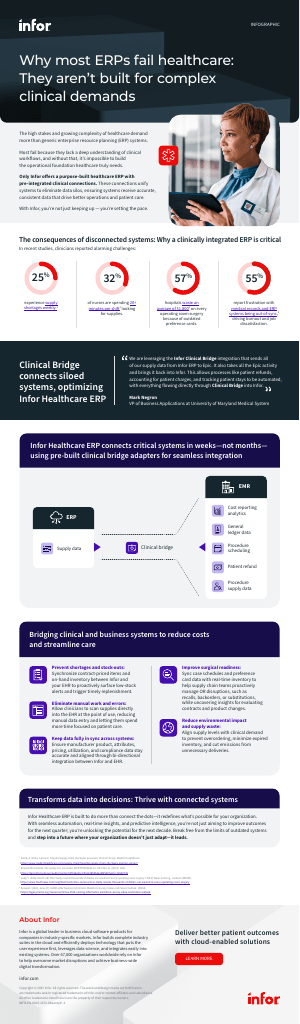
Most organizations can't see these ripple effects in real time — not because the data doesn't exist, but because it lives in disconnected systems, separated from the people and decisions that need it most.
Blog: Why connected systems are the backbone of patient-centered care

The Challenge — Why disconnection is a healthcare crisis

The pressures aren't separate problems. They're connected symptoms of a fragmented operating model.

86,000

Physician shortage projected by 2036

Structural workforce pressure — not cyclical. Source: AAMC, 2024.

2:1

Admin hours for every hour of direct patient care

Clinicians spending time on paperwork rather than patients. Source: Sinsky et al., 2016.

12.3%

Year-over-year increase in supply expenses

While operating margins remain under pressure. Source: HFMA, 2026.

50%+

Of hospital operating expense is labor

The single largest cost driver — and the most complex to manage. Source: AHA, 2026.

25-30%

Of U.S. healthcare spending estimated to be admin waste

The majority driven by billing complexity, redundant processes, and disconnected systems. Source: JAMA, 2019.

Care depends on three foundations. None can succeed in isolation.

Each function has distinct priorities — but all three ultimately support the same goal: delivering high-quality patient care. The question isn't which one to prioritize. It's how to connect them.

WORKFORCE · DELIVER CARE

Qualified clinicians available to deliver care — connected to demand and financial reality.

Scheduling, HR, payroll, and talent management connected to patient demand and financial constraints — not managed separately from the outcomes they drive. When a nurse calls out, intelligent ...

FINANCE · SUSTAIN CARE

Resources and investments connected to labor, supply, and performance in real time.

Financial performance connected to labor costs, supply spend, and operational data in real time — not reconstructed after the fact. Cash flow forecasting analyzes payer behavior and historical...

SUPPLY CHAIN · ENABLE CARE

Supplies connected to clinical demand signals and financial constraints.

Demand forecasting analyzes historical consumption alongside surgical volumes and census projections. Reorder points dynamically optimized so supply teams respond before a shortage is already ...

When these foundations operate from a connected platform, organizations can see and respond to operational challenges as an enterprise — not as three departments solving the same problem in different rooms.

When healthcare works together, better outcomes follow.

The challenge isn't that workforce, finance, and supply chain leaders lack information. It's that the information they have doesn't travel. A staffing decision gets made without visibility into patient demand. A supply order goes out without insight into the financial constraints it creates. A financial forecast gets built without accounting for the labor pressures already in motion.
Connected operations close that gap. When all three functions run on a shared foundation, leaders gain a more complete view of the factors influencing performance — allowing them to anticipate challenges, align resources, and make more informed decisions across the enterprise. Not because they hired more analysts. Because the data that already existed finally reached the people who needed it.
The financial pressure is real and growing. Supply expenses increased 12.3% year over year while many organizations continue to navigate reimbursement pressure and tight operating margins. As operational complexity grows, so does the need for a more connected approach — and a platform built to support it.
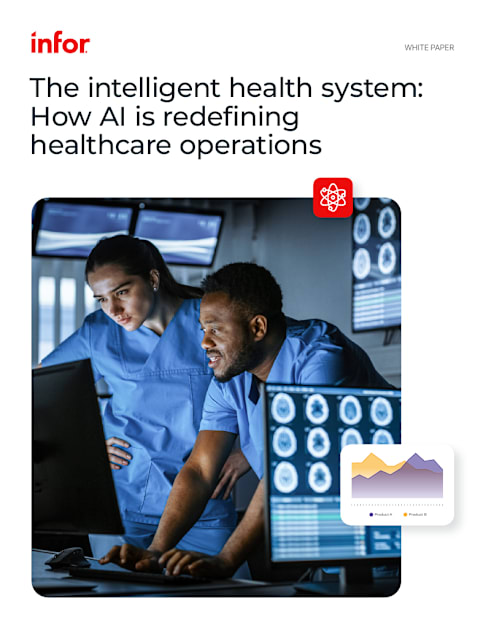
Learn how connected data, intelligent automation, and AI are helping healthcare organizations build more responsive and resilient operations.
Organizations that connect workforce, finance, and supply chain are better positioned to:

Staff are available to meet patient demand 

without relying on premium labor or manual scheduling processes


Supplies are available when/where needed

before a shortage is already affecting clinical workflows


Leaders gain greater operational visibility

across workforce, supply chain, and finance in a single view


Financial performance improves

with fewer surprises, faster forecasting, and cleaner cost data


Care delivery is strengthened

because the operational foundations that support it are no longer working at cross-purposes


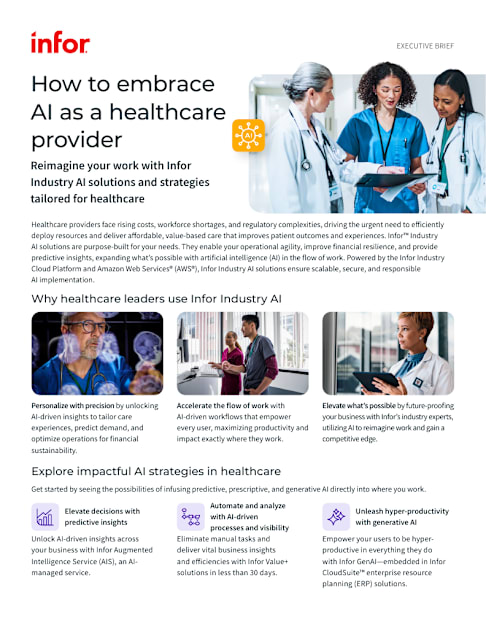
AI is only as effective as the data behind it.

70% of healthcare organizations are actively using AI. The majority have moved past rules-based automation and into generative AI — and agentic AI, systems that don't just advise but act across multi-step workflows, is emerging now. The organizations already seeing 20%+ cost savings share one trait: connected operational data was already in place before AI was introduced. The gap between results and pilots is not ambition — it's foundation. Source: Deloitte, 2025.

Data must be connected before it can become intelligence → Processes must be connected before they can be automated → Teams must be connected before technology can improve outcomes.

WORKFORCE

Open shifts filled before a manager makes a single call.

AI-enabled scheduling analyzes real-time census data, acuity levels, credentials, and labor rules — identifying available staff and broadcasting open shifts through a mobile interface. Gaps fi...

FINANCE

Invoice processing automated. Exceptions surfaced for human review.

Healthcare invoices arrive in non-standard formats with specialized billing codes requiring compliance validation. AI extracts, validates against contract terms, and routes exceptions — mainta...

SUPPLY CHAIN

Supply demand predicted. Stockouts and excess inventory reduced.

Demand forecasting analyzes historical consumption alongside surgical volumes and census projections. Reorder points dynamically optimized — not set statically. Vendor performance analyzed for...


Infor Velocity Suite — industry AI built into CloudSuite Healthcare

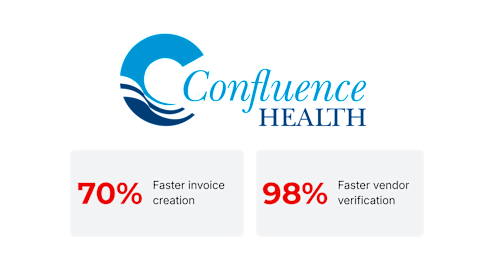
Industry-specific AI agents, GenAI, process mining, and automations — embedded in CloudSuite Healthcare, not bolted on through a third-party integration. One flat fee. Unlimited consumption. A team of Infor experts included. Confluence Health reallocated a full FTE and reached 70% faster invoice creation in under 30 days.
Discover Infor Velocity Suite

Different starting points. One outcome.

Healthcare organizations connect from different starting points. Some begin with supply chain. Some start with workforce. Some lead with finance. The path differs — the outcome doesn't.

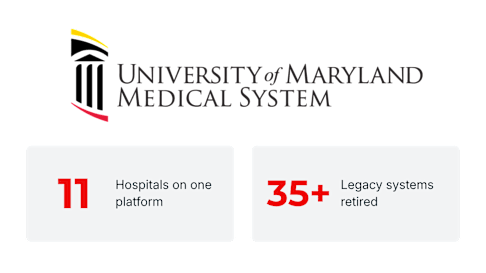
University of Maryland Medical System

STARTING POINT: SUPPLY CHAIN & FINANCE

AI-enabled scheduling analyzes real-time census data, acuity levels, credentials, and labor rules — identifying available staff and broadcasting open shifts through a mobile interface. Gaps fi...
Confluence Health

STARTING POINT: FINANCE & SUPPLY CHAIN AI

Healthcare invoices arrive in non-standard formats with specialized billing codes requiring compliance validation. AI extracts, validates against contract terms, and routes exceptions — mainta...
Watch the Confluence Health story

Children's of Alabama

STARTING POINT: WORKFORCE MANAGEMENT

Demand forecasting analyzes historical consumption alongside surgical volumes and census projections. Reorder points dynamically optimized — not set statically. Vendor performance analyzed for...

"We expected it would take at least 6 months to see results, but within the first month we reallocated a full FTE and saw a noticeable increase in employee satisfaction. That quick turnaround is what we're most proud of."


Stace Webley Financial Systems Support Manager, Confluence Health


“Our supervisors were able to cut the time spent on closing the pay period in half. Less time spent on incentives for hard to fill shifts. Employees have more control over their schedule. ”


Gina Seekers Dir HRIS, Children's of Alabama


"As Infor already provides services to thousands of customers on a shared infrastructure, it’s in a much better position to ensure the system runs optimally, as well as provide security and disaster recovery. This frees us up to focus on what we’re good at – providing patient care."


Murry Mercier CIO, ProMedica Health System


“Infor CloudSuite Healthcare made processing invoices easy and fast.”


Gwendolyn Martin Lead Accounts Payable Clerk, Cooper University Health Care


“Infor provides the one source of truth that may have been lacking when we operated in silos.”


Health Care Providers & Services Company


“Greatly improved visibility of supply chain data (usage, spend, etc). Now, we have the ability to see and track cross company transactions, which was missing in our legacy system.”


Application Analyst II, Health Care Providers & Services Company


“Having everything in one platform has made it easier to maintain.”


Jodie Case
Payroll/AP Manager, Lee Health

See how healthcare organizations are modernizing their technology foundations to improve visibility, reduce complexity, and accelerate innovation.

Industry-built for healthcare. Not configured for it.

Unlike horizontal ERP vendors that require costly integrations and years of customization to approximate healthcare functionality, CloudSuite Healthcare is designed from the ground up for healthcare complexity — multi-entity structures, clinical credentialing, HIPAA compliance, and EHR integration built in. Generic ERP platforms force organizations to absorb the cost of customization for years after go-live. The platform is what makes it possible. The industry depth is what makes it work.
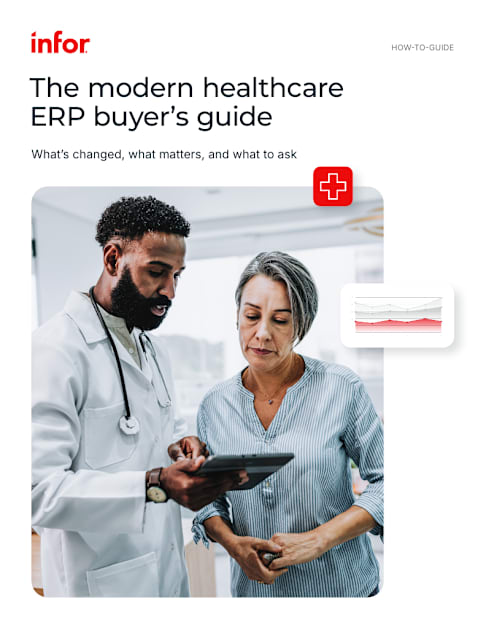
Choosing the right platform starts with the right questions. Explore the criteria healthcare leaders use to evaluate modern ERP solutions.

750+

U.S. Healthcare organizations partnered with Infor

35+

Legacy systems retired per health system on average

88%

Average increase in operational efficiency reported

15 mo

Average time to ROI realization

114%

ROI for organizations consolidating on industry-specific cloud ERP

$19.72M in 3-year benefits vs. $9.20M in costs Forrester TEI, 2025

37%

Reduction in integration and maintenance costs on average

Preconfigured templates shorten implementation by up to 6 months Nucleus Research, 2025

54%

Faster time to value than industry average

Results in as few as 9 weeks Nucleus Research, 2025

One Platform. Seventeen Industries. Customized for Every One.

The same connected platform architecture powers industry-specific operations across 17 verticals. Healthcare runs on the same Infor OS foundation — unified data fabric, Industry AI, and cloud infrastructure — as Infor's solutions for food & beverage, manufacturing, distribution, aerospace, and hospitality. What's different is that each CloudSuite is engineered for its industry's specific processes, vocabulary, and compliance requirements. Not one-size-fits-all. Purpose-built for how each industry actually works.

Distribution

Industrial Manufacturing

Healthcare

Aerospace & Defense

Food & Beverage

High Tech & Electronics

Hospitality

Fashion & Apparel

Automotive

Chemicals

Equipment

Logistics

Retail

Public Sector

Construction & Engineering

Financial Services

Utilities

Go Deeper.

These resources cover the operational case, the AI execution playbook, the ERP evaluation framework, and what connected healthcare looks like from the inside — most are ready to read right now.

See what's possible with connected healthcare

Discover how connected operations, Industry AI, and healthcare-specific technology can help your organization improve performance across workforce, finance, and supply chain.